Float blog

My phone, my family, and Dopamine Nation

Too much pleasure is its own pain.

I found this book while I was trying to break my own phone habit. A Stanford addiction psychiatrist explains why the easy rewards all around us leave us more anxious and less satisfied, and why the way back starts with stepping away. Here’s what she says, how I live it, and why a float tank is the best place I know to let the seesaw settle.

1 daya week without my phone
1 monthoff alcohol, about every 6 months
60 minin a float with nothing to reach for

How I found this book

A while back I admitted something to myself: I was addicted to my phone. So once a week, I put it down. I go for long walks, I write, and I read.

On one of those days I took Dopamine Nation by Dr. Anna Lembke to my local coffee shop and read half of it in one sitting. It explained exactly what I’d been feeling: why the phone kept pulling me back, why I felt flat and restless when I was on it, and why putting it down got easier the more I did it.

This post is what I took from it, and why I think a float or a contrast session is one of the best tools you have to get your balance back.

Mark, owner of Float Boston

Why this book hit home

Dopamine Nation: Finding Balance in the Age of Indulgence came out in 2021 and became a New York Times bestseller. For me, it was personal.

My family

Addiction runs in my family.

My grandmother was a heavy smoker and drinker. My father struggled with drugs and alcohol. One of my uncles died of an overdose, and another is addicted to pain medication. Before she passed, my mother became an alcoholic, more to ease her pain than anything else.

So I don’t take this lightly. I like a drink. But about every six months, I quit cold turkey for a month, just to make sure I still have a handle on it. I do something similar with my phone: one day a week, or most of one, it stays down.

I didn’t know if that system made sense until I read this book. It turns out it lines up closely with what Lembke prescribes.

I don’t test myself because I think I have a problem. I test myself so I never find out the hard way.
The author

An addiction doctor looking at the rest of us.

Anna Lembke is a psychiatrist at Stanford, where she is medical director of the Stanford Addiction Medicine Program. She has spent her career treating people addicted to drugs and alcohol.

Her argument is that the same brain process behind addiction is now working on all of us. Not because we’re weak, but because we live surrounded by easy, constant rewards our brains never evolved to handle: phones, sugar, shopping, streaming, porn, news.

The seesaw

Every high comes with a hangover.

Lembke’s central image is a seesaw. Pleasure and pain are processed in the same parts of the brain, and the brain always wants to keep them level.

So when something tips you toward pleasure, the brain pushes back the other way. That’s the comedown and the craving for one more scroll, one more bite, one more episode.

Do that all day for years and the brain adjusts for the long haul. Lembke calls it a dopamine deficit state: anxiety, irritability, poor sleep, a flat mood, and needing more of the thing just to feel normal. We wrote recently that the average American checks their phone 186 times a day. That’s the seesaw getting pushed about every five waking minutes.

The problem isn’t that we feel too little pleasure. It’s that we chase so much of it we can’t feel it anymore.
Stress

Stress keeps your hand on the seesaw.

Here’s the loop most of us live in. You feel stressed or anxious, so you reach for something that feels good fast. The good feeling fades, the seesaw tips back, and you feel a little worse than before. So you reach again.

That isn’t just a feeling. Yale researcher Rajita Sinha has spent years showing that stress is one of the strongest drivers of craving and relapse. Stress and the brain’s reward system are wired together. And anxiety is one of the symptoms Lembke describes when the seesaw stays tipped toward pain.

Which means one of the best ways to stop reaching is to lower the stress that makes you reach.

The reset

Thirty days without it.

The first thing Lembke has most patients do is a dopamine fast: about 30 days away from their main source of pleasure, then a return in moderation, if at all. It’s almost exactly my month off alcohol.

She’s upfront that it gets worse before it gets better. For many people it starts to ease after about two weeks, and small pleasures, a walk, a meal, a conversation, start to register again.

One important warning she gives: don’t quit heavy alcohol or drug use cold turkey on your own. Withdrawal can be dangerous and needs a doctor.

Willpower

Don’t rely on willpower. Build a wall.

Lembke calls it self-binding: putting barriers between you and the thing you overdo before the craving shows up. Physical distance, like charging your phone in another room. Time limits, like my phone-free day. Or cutting out a whole category.

A float tank is all three at once. Your phone stays outside. The hour has a fixed start and end. And inside there’s nothing to reach for: no light, no sound, no screen, no snack.

What surprised me is what that does afterward. Even one hour away from the things that spike you has an almost magical effect on willpower. You walk out having proven you can go without. The pull is quieter. Saying no feels easier for the rest of the day. That’s my experience, not a study.

The easiest habit to break is the one you physically can’t reach.
The float

The one place the seesaw can settle.

Think about what’s happening in a float tank. Nothing is pushing your seesaw in either direction. No hit of pleasure, no notification, no craving to answer. You aren’t even fighting gravity. You’re lying in about 10 inches of skin-temperature salt water, held perfectly level.

We can’t tell you a float resets your dopamine. Nobody has studied that, and I won’t make it up. What we can tell you is that floating reliably lowers stress and anxiety, the same stress that keeps your hand on the seesaw. In a 2018 study, 50 people with anxiety and stress-related disorders did a single one-hour float. They reported significant drops in stress, anxiety and muscle tension.

Less stress means less reaching. Less reaching gives the seesaw a chance to level out. It’s the closest thing I know to a reset button.

Book a float and give your seesaw an hour off →

The pain side

A little discomfort tips you back.

Here’s the part of the book that surprises people. The seesaw works both ways. A small, deliberate dose of discomfort is followed by a pull toward pleasure, and that lift comes from your own body and tends to last longer.

Lembke’s examples include exercise, fasting and cold water. One of her patients, recovering from drug addiction, took ice baths every day and described the lift afterward as close to the highs he used to chase.

The research on cold water backs this up, at least in part. In a study from Prague published in 2000, ten young men sat in 57°F water for an hour. Dopamine in their blood rose about 250%.

That’s exactly what our contrast suite is built for: a sauna and a 52° cold plunge, back and forth, in a private room. The first 30 seconds in the cold are hard. That’s the point. You climb out clear, calm and awake, and you earned it.

Book a contrast session and press on the pain side →

Try your own reset

Here’s the version I use, built on Lembke’s approach. Start this week:

  1. Name the one thing. The habit you reach for most, the one you’d be embarrassed to see a weekly report on.
  2. Put it down on a schedule. One day a week to start, like my phone day. Work up to 30 days off if you can.
  3. Build the wall first. Move it out of reach before you need willpower: another room, a time limit, or a hard “not this category.”
  4. Book an hour with nothing. A float on day one of your reset. Phone outside, nothing to reach for, stress turned down.
  5. Add a little discomfort. A contrast session or a cold plunge each week to press on the pain side.

Less, on purpose.

I’ve watched what chasing relief did to the people I love. The message of Dopamine Nation isn’t that pleasure is bad. It’s that the constant chase leaves us flatter than when we started, and that the way back is less input and a little more challenge.

We built rooms for both. A cold plunge that presses on the pain side. And a float tank, the one place where nothing pushes your seesaw at all, so it can finally settle.

Let your seesaw settle.

Float Boston is at 515 Medford Street in Somerville, open every day from 7:30 a.m. to 9 p.m.

Your first float is discounted with the code firstfloat. Want to make it a habit? The beginner package is 3 floats for $169, and you get a 4th free if you use all 3 within 60 days.

Floating and contrast therapy are wellness practices, not medical treatments, and nothing here is medical advice. This post discusses Dopamine Nation by Anna Lembke, MD. Neither she nor the researchers cited are affiliated with Float Boston. If you’re struggling with alcohol or drug use, don’t quit on your own; talk to a doctor or call the free, confidential SAMHSA National Helpline at 1-800-662-4357. Check with your doctor before cold plunging if you have a heart condition or high blood pressure.

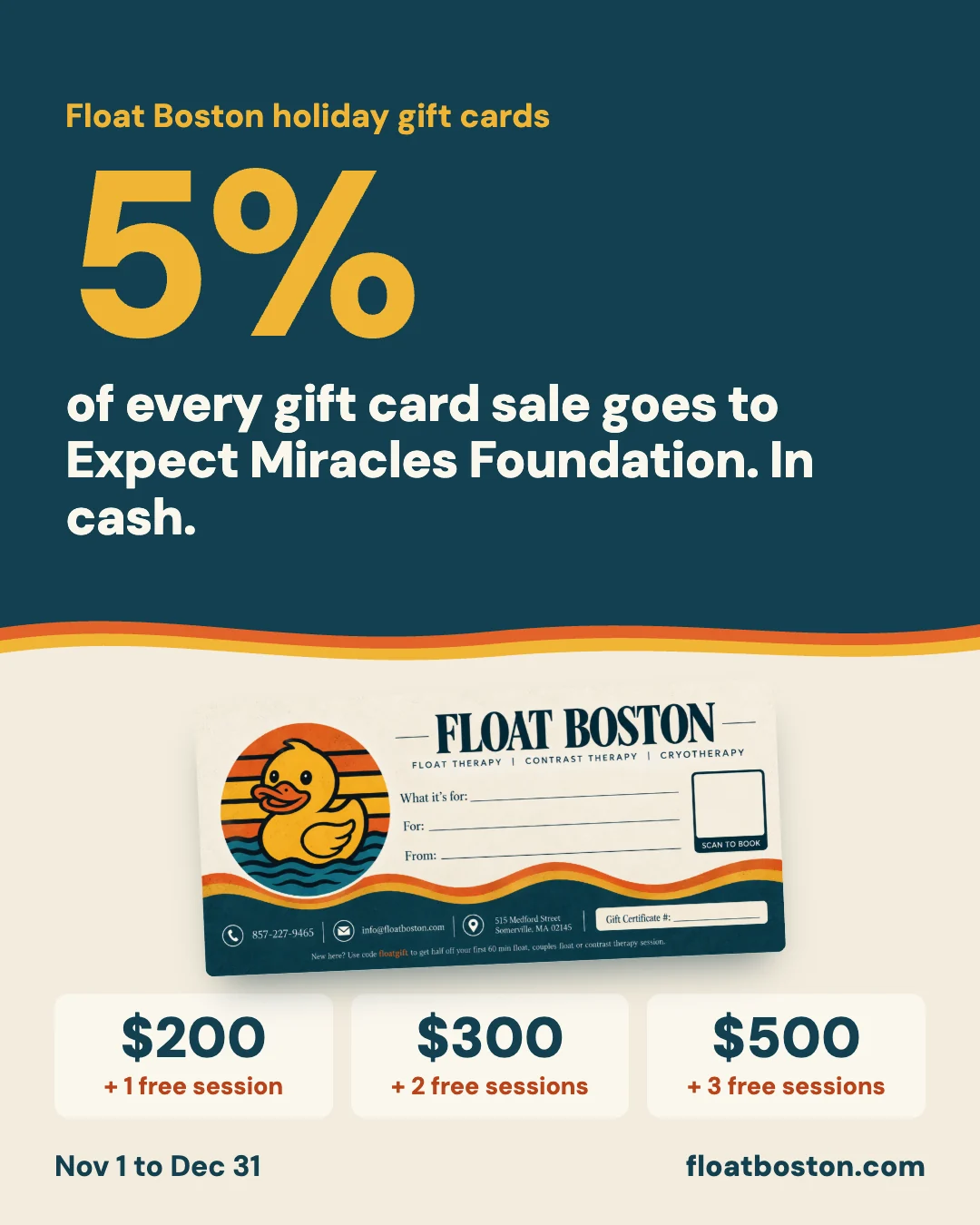
Free service with gift card purchase

gift cards

Give the gift of floating and help fight cancer at the same time only at Float Boston. Buy online and get a PDF or come in-store and get one of 2 limited time gift card designs.