The deepest rest
your body has ever had
What floating is, why it works, what to expect, and everything in between. All in one place.
Use code firstfloat to get half off your first float or couples float!
Science-backed. Completely effortless.
Float therapy is a science-backed relaxation practice where you lie effortlessly in a warm, private tank filled with highly concentrated Epsom salt water. The environment removes external stimulation completely — no pressure on your joints, no light, no sound — allowing your mind and body to fully decompress.
With gravity and sensory input reduced, your nervous system shifts into deep rest. Stress hormones drop. Muscles release tension they've been holding for years. Mental noise softens. Many people describe the experience as the first time they've truly felt nothing — and that nothing is everything.
You don't need to meditate. You don't need to be good at relaxing. If you have a body and a mind, floating meets you where you are.
Everyone has a different reason.
The results speak for themselves.
Stress & anxiety relief
Float therapy offers a complete sensory reset, easing you out of fight-or-flight mode. With no light, sound, or pressure, your nervous system can deeply relax — reducing anxiety, quieting racing thoughts, and promoting better sleep, all without effort or side effects.
Pain relief & physical recovery
Floating removes pressure from joints and muscles, helping your body decompress and heal. Magnesium-rich water eases soreness and inflammation while triggering your natural relaxation response — offering pain relief and faster recovery with zero effort.
Sleep & insomnia relief
Floating calms the mind and relaxes the body, helping reset your natural sleep rhythms without medication. By easing stress and sensory overload, it supports deeper, more restorative rest — often lasting for days after a single session.
Mental clarity & mindfulness
By removing all distractions, floating guides you effortlessly into meditative states. Experience deep mental stillness, heightened awareness, and enhanced creativity — without effort, posture, or practice. The tank becomes a gateway to genuine inner quiet.
Float for your body, mind, and soul
Body
In the float tank, the body gets to rest in a way that's almost impossible anywhere else. The weightless environment removes pressure from joints and muscles, releasing tension and easing chronic pain. Warm Epsom salt water supports circulation, reduces inflammation, and promotes faster physical recovery. Deeply restorative for anyone dealing with stress, soreness, or physical burnout.
Mind
Floating gives your mind a rare break from constant input. With no noise, no screens, and no demands, your brain finally has space to settle. Many people experience improved focus, clearer thinking, enhanced creativity, and a noticeable reduction in mental fatigue. It's a reset for your cognitive system — quiet, spacious, and profoundly restorative.
Soul
Floating creates a calm internal space where you can reconnect with yourself. Free from external distractions, many people experience a sense of peace, emotional grounding, and even personal insight. Whether you use the time for meditation, reflection, or simply quiet presence — floating provides a sanctuary for your inner world.
Three tanks. One incredible experience.
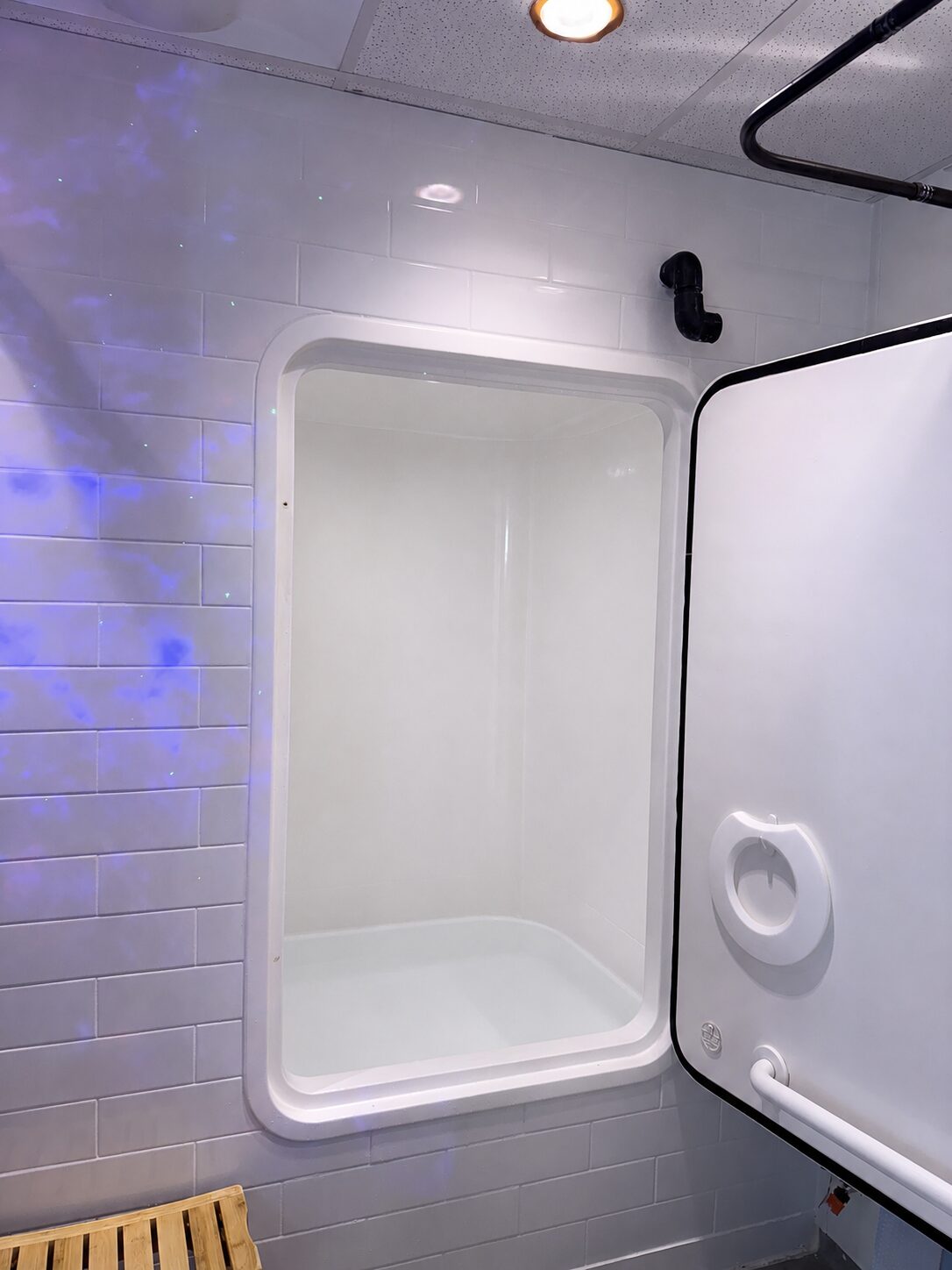
Summer Sky
Our two Summer Sky tanks are the ideal choice for first-time floaters or anyone who wants a little more comfort and control. Taller design with more headroom, and interior starlight lighting you can turn on or off. Many people with claustrophobia find these tanks significantly easier to settle into.
Size: 7 ft long
Lighting: Interior starlight (fully controllable)
Best for: All floaters, claustrophobia concerns, mobility needs
Default: Full sensory deprivation. Music upon request, lights & stars controlled from the inside.

The Depths
Our new XL tank takes floating to a completely different level. Larger, wider, and deeper than any standard tank — designed to give you the sensation of drifting through infinite dark space. One of only a handful of centers in the area offering a tank of this size and depth. This is floating at its most immersive.
Size: 8 ft long · extra wide
Experience: Maximum sensory isolation
Best for: Anyone who really wants to stretch out, deeper immersion
Default: Full sensory deprivation. Music upon request, lights controlled from the inside.
What to expect, from arrival to after
Before you arrive
You don't need to bring a thing. We provide towels, soap, shampoo, leave-in conditioner, hair dryers, lotion, earplugs, and even post-float tea and coffee. If you wear contacts, bring a case and solution. If you have long hair, a brush is useful.
Try to avoid caffeine for a few hours beforehand — stimulants make it harder to settle in. If you've recently colored your hair, wait a few days before floating as fresh dye can react with the salt. Arrive about 10 minutes early so we can walk you through everything.
Your room is completely private — no bathing suit needed. Though if you're more comfortable wearing one, that's completely fine.In the tank
The first 10 minutes can feel restless — your mind is still busy and your body hasn't let go yet. This is completely normal. Every first-time floater goes through it. Just breathe. Let it happen.
Then something shifts. Your body stops bracing. Your thoughts slow down. This is the float. Most people find their arms most comfortable resting above or behind their head rather than at their sides. If you get salt in your eyes, use the spray bottle provided to rinse. We have optional neck float assists if you want extra support.
About two minutes before your session ends you'll hear a gentle alarm. When the water begins to move, that's your cue to step out.
If you'd like meditation music during your float, let us know before your session. We have a full selection available.After your float
Take your time getting out of the tank. Enjoy your final shower, leave your towels in the room, and ease back into the world slowly. Many people feel lighter, looser, and unusually calm. Some feel energized. Some feel almost dreamlike. All of it is normal.
You're welcome to stay and enjoy complimentary coffee or tea, or simply sit quietly for a few minutes before heading back out. And don't forget your free rubber duck and free sticker on the way out!
The benefits often extend into the evening — many people notice deeper sleep and a lingering sense of calm that carries into the next day.What we provide
Everything. Towels, washcloths, soap, shampoo, leave-in conditioner, hair dryers, lotion, earplugs, makeup remover, ointment for small cuts, bottled water, and one of our rotating rubber ducks — yes, yours to keep. Post-float tea and coffee always available.
How often should you float?
There's no single right schedule — but consistency matters more than intensity.
Getting started
If you're using floating for something specific — stress, anxiety, poor sleep, chronic pain — starting with a more frequent rhythm helps your nervous system learn the pattern faster. Weekly floating for the first month is a good foundation.
Ongoing practice
Many regular floaters settle into biweekly or monthly sessions as a reset point. As your system adapts, the effects deepen and last longer between sessions. You'll notice you need less time to settle in and come out further than before.
The long game
Think of floating like sleep or exercise — doing it once feels great, but repetition creates lasting change. Regular floaters report improved baseline stress resilience, better sleep quality, and a calmer default state that exists outside the tank.
This isn't just relaxation.
It's physiology.
Floating has been studied for decades under the name flotation-REST — Restricted Environmental Stimulation Therapy. Research has shown that repeated sessions can significantly reduce cortisol (the body's primary stress hormone), lower blood pressure, and improve mood and emotional regulation.
More recent research suggests floating may help regulate the autonomic nervous system — the system responsible for shifting between fight-or-flight and rest-and-repair. With regular exposure to a low-stimulation environment, the nervous system becomes more flexible, making it easier to return to a calm baseline even in everyday life.
The water in our tanks is saturated with pharmaceutical-grade Epsom salt — magnesium sulfate. Magnesium plays a critical role in how the body manages stress, muscle tension, and recovery. Many people report feeling looser and calmer after floating, particularly in areas prone to chronic tension like the neck, shoulders, and lower back.
Read the research at NIH PubMed →Notable people who swear by it
From consciousness research
to mainstream wellness
Neuroscientist Dr. John C. Lilly set out to study human consciousness in an environment free from external stimulation. His early isolation chambers were fully enclosed, dark, and soundproof — designed to explore how the brain behaves when sensory input is removed. These experiments laid the groundwork for modern float therapy.
Float tanks evolved from research equipment into wellness tools. Designs became more comfortable, incorporating shallow pools of warm, buoyant Epsom salt water. Interest grew as people began reporting deep relaxation, pain relief, and improved mental clarity. Commercial float centers slowly began to appear.
Floating surged in popularity due to increased scientific research, media coverage, and the rise of wellness culture. Today, float therapy is widely embraced for stress reduction, athletic recovery, mental health support, and mindfulness. What began as a consciousness experiment has become an evidence-based practice for restoring balance in the modern world.
Questions people ask
Heat, cold, repeat.
Floating slows everything down. Contrast therapy wakes everything up. Cycle between our sauna and cold plunge and you'll walk out flushed, clear-headed, and buzzing in a completely different way. Plenty of our regulars do both.
Half off your first float
Use code firstfloat to get half off your first float or couples float!
No experience needed. Everything is provided. Somerville, MA.
Book my first floatStay in the loop
Sign up for our newsletter and get first dibs on specials, info on floating, and more.
Sign me up