When the light leaves Boston
Why winter gets heavy
Every November the clocks fall back, the sun sets before most of us leave work, and a lot of people start feeling flat, tired and not quite themselves. There’s a name for that, a reason it happens, and things you can do about it.
Boston, on each solstice. In December the sun sets around 4:12 PM.
What seasonal depression is
Seasonal affective disorder, usually shortened to SAD, is a type of depression that follows the calendar. For most people it starts in late fall, peaks in January and February, and lifts in spring. It’s a recognized clinical condition, not a mood or a weakness.
Common signs include low mood most of the day, losing interest in things you usually enjoy, sleeping more and still feeling tired, craving carbs, gaining weight, and wanting to pull away from people. The American Psychiatric Association estimates about 5% of U.S. adults have SAD, and many more deal with a milder version most people call the winter blues.
It’s also more common the farther you live from the equator. New England qualifies.
Why it happens
Researchers don’t have one clean answer, but three things keep showing up.
Your internal clock drifts
Your circadian rhythm runs on light, especially morning light. When mornings stay dark, that clock can fall out of sync with your actual day, which shows up as grogginess, poor sleep and low energy.
Serotonin and melatonin shift
Less sunlight is linked to lower serotonin activity, a brain chemical tied to mood. At the same time, long dark evenings push the body to make more melatonin, the hormone that makes you sleepy. Less of one, more of the other, is a recipe for feeling sluggish and low.
Life shrinks
This one gets less attention. In winter we move less, see friends less, and spend more time inside on screens. Cold, dark and isolated is hard on anyone’s mood, and it tends to feed on itself.
First, the honest part
Floating and contrast therapy are not treatments for depression, and I won’t pretend they are. The best-supported treatments for SAD are light therapy, talk therapy (especially CBT), and in some cases medication. If you think you have SAD, please start with your doctor.
If you’re in a dark place right now, call or text 988, the Suicide & Crisis Lifeline, any time.
What I can tell you is that floating and contrast therapy are good tools for the other half of the problem: stress, sleep, energy, and taking real time for yourself when winter makes that hardest. Here’s what the research says.
— Mark, owner of Float Boston
How floating can help
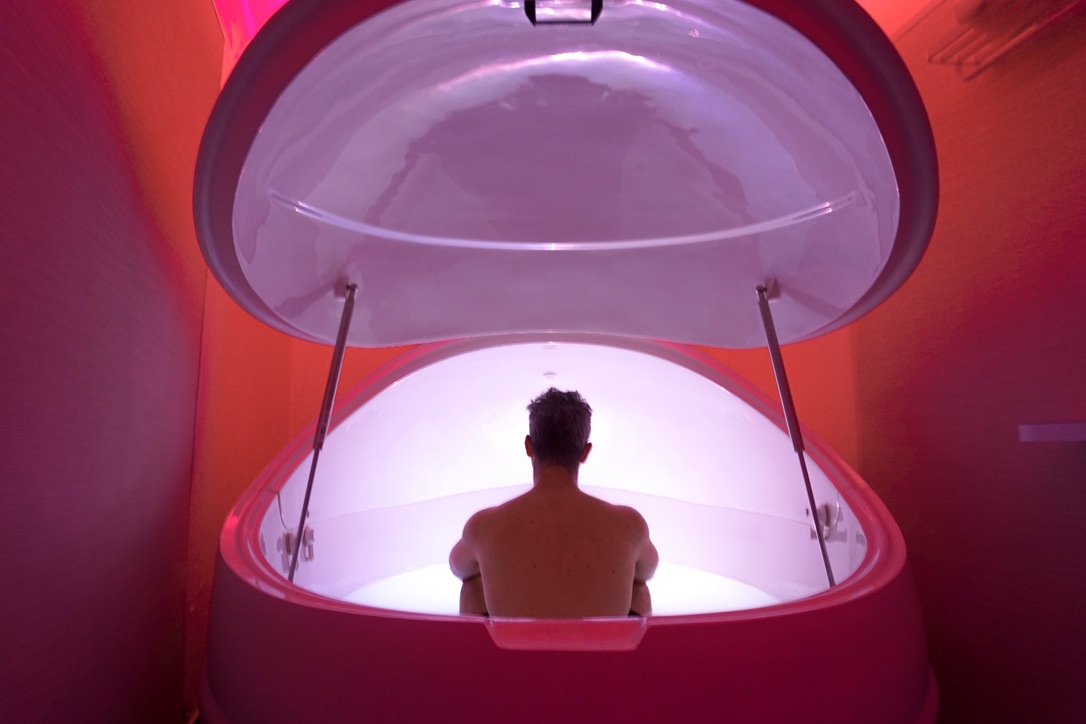
A float is an hour lying in warm water so full of Epsom salt that you can’t sink. The room is dark and quiet. With almost nothing coming in through your senses, your nervous system gets a rare chance to downshift out of fight-or-flight.
That matters because stress and anxiety tend to ride along with winter depression, and they make it worse. In studies, floating has been shown to lower stress and anxiety, lift mood and improve sleep, and the effects tend to build when people float regularly.
Winter tells you to hide. A float is a way to rest on purpose instead.
There’s also something simple about it. You can’t check your phone. You can’t scroll. For an hour, the only thing you’re doing is being still, which is exactly the thing most of us stop doing in January.
How contrast therapy can help
Contrast therapy means moving between heat and cold: our sauna runs around 160°F and our cold plunge stays at 52–54°F. If floating is the calm, contrast therapy is the jolt.
The cold. Cold water triggers a big release of noradrenaline and dopamine, the brain chemicals behind alertness, focus and motivation. In one well-known study, people sitting in cold water saw noradrenaline rise about fivefold and dopamine about 2.5 times. Most people step out of the plunge feeling wide awake and noticeably better, which is a welcome feeling on a gray February afternoon.
The heat. There’s early research on heat and mood too. In a small clinical trial, a single session of whole-body heating reduced depression symptoms for weeks compared with a sham session. That study used a medical heating device, not a gym sauna, so treat it as a promising lead rather than proof. Still, anyone who has sat in a hot sauna on a freezing day knows the feeling.
Going back and forth also gives you a small, hard thing to do and finish. In a season where it’s easy to feel stuck, that counts for something.
What the research actually shows
Another study had 65 people float 12 times over seven weeks. Their stress, depression, anxiety and pain went down, and their optimism and sleep quality went up (Kjellgren & Westman, 2014). These are small studies, and none of them tested people with SAD specifically. But they point in the same direction.
Sources
- National Institute of Mental Health. Seasonal Affective Disorder. nimh.nih.gov
- American Psychiatric Association. Seasonal Affective Disorder (SAD). psychiatry.org
- Jonsson K, Kjellgren A. Promising effects of treatment with flotation-REST for generalized anxiety disorder: a randomized controlled pre-post trial. BMC Complementary and Alternative Medicine. 2016;16:108.
- Feinstein JS, et al. Examining the short-term anxiolytic and antidepressant effect of Floatation-REST. PLOS ONE. 2018;13(2):e0190292.
- Kjellgren A, Westman J. Beneficial effects of treatment with sensory isolation in flotation-tank as a preventive health-care intervention. BMC Complementary and Alternative Medicine. 2014;14:417.
- Šrámek P, et al. Human physiological responses to immersion into water of different temperatures. European Journal of Applied Physiology. 2000;81(5):436–442.
- Janssen CW, et al. Whole-body hyperthermia for the treatment of major depressive disorder: a randomized clinical trial. JAMA Psychiatry. 2016;73(8):789–795.
A simple winter routine
None of this has to be complicated. What helps most is having a plan before February gets here.
- Get morning light. Go outside within an hour of waking, even when it’s cloudy. Ask your doctor whether a light therapy box makes sense for you.
- Float every week or two. Put it on the calendar like any other appointment. The benefits build when you float regularly.
- Add contrast therapy when you’re dragging. A few rounds of sauna and cold plunge is one of the fastest ways we know to feel awake again.
- Keep seeing people. Bring a friend to a couples float or a contrast session. Winter isolation is part of the problem, so make the reset social.
- Talk to someone if it doesn’t lift. If low mood lasts more than two weeks or gets in the way of work and relationships, talk to your doctor or a therapist.
Don’t wait for spring
We’re open every day from 7:30 AM to 9 PM at 515 Medford Street in Somerville. Come float, sweat, plunge, or all three.
Use code firstfloat to get half off your first float or couples float. First contrast session is $50 with code love2sweat.
Planning to float through the winter? Our beginners package is buy 2, get 1 free, and you get a 4th float free if you use all three within 60 days.
This post is for general information and isn’t medical advice. Floating and contrast therapy are not treatments for depression or any other condition. Talk to your doctor before starting cold plunge or sauna use if you are pregnant or have a heart condition, high or low blood pressure, or other health concerns. If you are in crisis, call or text 988.